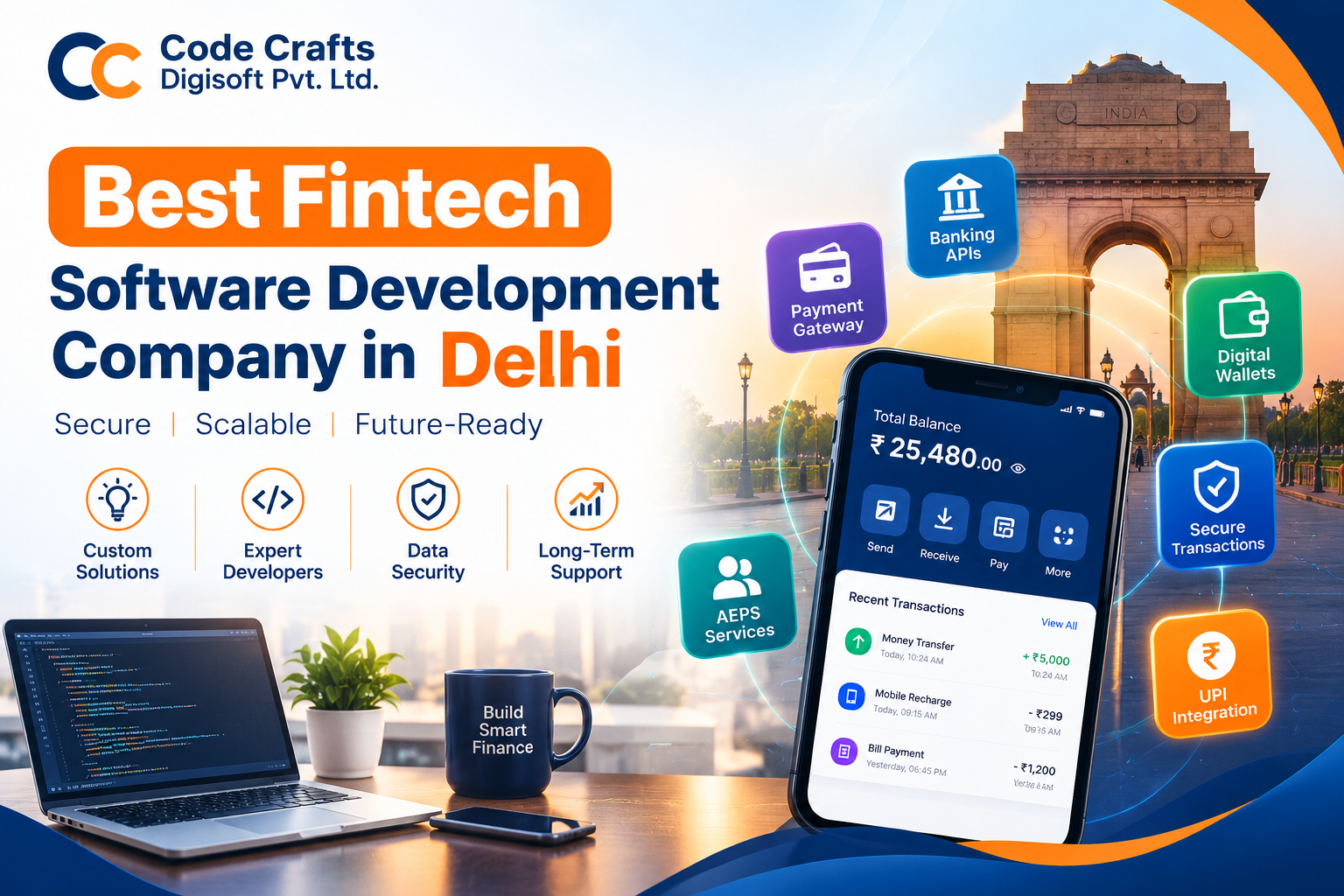
Best fintech software development company in Delhi: this is the phrase founders, bank teams and payment businesses search on Google before making an important decision, and this is also the phrase that makes your screen fill up with almost identical claims. Every fintech claims to be the best. Every website shows the same handshakes and beautiful dashboards.
So how to distinguish the team that is able to build a secure, fast and compliant product from the one that is just good in selling? This is the topic of the current guide. We are going to discuss the Delhi NCR fintech market, companies people refer to as "fintech in Delhi", the services you can order, and the criteria that make one fintech provider better than another.
Somewhere along the way, we will reveal the single criterion that most buyers overlook until it is too late, usually after signing the contract. At the end of the guide, we are going to answer some commonly asked questions, like "Is fintech still in demand?" and "Is fintech a high risk industry?". Just a quick note: we are Code Crafts Digisoft, a Jaipur-based fintech and software company.
Fintech Software Development in Delhi: A Quick Look at the Market
There is one big advantage that the fintech software development in Delhi offers – the area is one of the busiest payment and financial products hubs in India. The Delhi NCR region, consisting of Noida, Gurugram and Delhi, houses popular fintech companies, a lot of skilled engineers and numerous financial businesses who require software.
It becomes a benefit when you need to buy something. You can get acquainted with your potential partners in person, hire local developers and vendors with experience in payments, lending, insurtech and banking software development. Of course, it brings a lot of competition, which is both good and confusing.
A short note about the geography. When you are searching for a fintech software development company in Delhi, you actually look for a company in the NCR region. Your future partner can be located either in Delhi, Noida or Gurugram, or even in another city but provide you with remote services. The main thing is the quality of services and not the location. For example, Code Crafts Digisoft is based in Jaipur and can work with you remotely using video calls and our office visits.
What Are the Top FinTech Companies in Delhi?
Fintech companies in Delhi NCR range from payment giants to young lending startups. These are some of the names that most often come up in public lists of the region's fintech scene:
| Company | Based in | Known for |
| Paytm | Noida | Digital payments, wallet, UPI and financial services |
| Pine Labs | Noida | POS terminals, payment infrastructure and prepaid solutions |
| BharatPe | New Delhi | Merchant QR payments and small-business lending |
| MobiKwik | Gurugram | Wallet, UPI payments and consumer financial services |
| PayU | Gurugram | Online payment solutions |
| PB Fintech (Policybazaar) | Gurugram | Online insurance and financial products marketplace |
| Stashfin | New Delhi | Digital lending |
| InstantPay | New Delhi | Payment and banking services |
| Code Crafts Digisoft | Jaipur | Fintech software development: AEPS, DMT, micro ATM, digital wallet, payout services and B2B, B2C and reseller portals |
Two things to remember. First, this is not a ranking. It is a list of popular names, and the headquarters and offices can change, so make sure to verify the information from the official website of each company before using any particular detail. Second, most of these are fintech product companies. They create and operate their own platforms, which is not the same as the software development company that creates fintech products for other companies. The last row is the latter: Code Crafts Digisoft is a Jaipur-based software development company, listed here as an option for businesses in Delhi NCR, but not as a Delhi NCR company. We will examine the difference below.
What Are the Top FinTech Software Development Companies?
Fintech software development companies are the teams that build the products, not the brands you see on your phone. A bank, a lender or a retailer network hires one to build payment apps, portals, wallets or lending platforms. Public "top" lists change often and each directory ranks by its own rules, so treat any single list as a starting point and not as a verdict.
It helps to know the main kinds of vendors before you shortlist:
| Type of vendor | Best for | Watch out for |
| Large IT services firms | Banks and big enterprises with large budgets and long timelines | Higher cost and slower pace, and smaller projects may get less attention |
| Fintech specialists (mid-size) | Payment, lending and wallet products that need real domain knowledge | Portfolio depth and who owns the code |
| Boutique studios | Startups and quick first versions | Limited capacity for large, long-term work |
| Product-plus-software firms | Businesses that want ready platforms such as AEPS, DMT or wallets that can be customised | Whether customisation and support are included in the price |
| Freelancers | Small, clearly defined tasks | Availability, security processes and continuity if the person leaves |
For most of the growing fintech companies, it is common that they eventually become either a fintech expert or a product and software firm. Code Crafts Digisoft is one such fintech and software company based out of Jaipur which falls under the latter category offering AEPS, DMT, micro ATM, digital wallet and payout solutions along with B2B, B2C and reseller portals. We have developed this guide, hence, kindly test us on the same criteria. The ideal way would be to apply all eight tests to the shortlisted companies.
Best Fintech Software Development Company in Delhi: 8 Checks Before You Sign
Here is a simple test you can run on any company on your list. Ask these eight questions and watch how clearly each one is answered.
| # | Check | What to ask | Red flag |
| 1 | Fintech experience | Which fintech products have you built, and can I speak to a client? | Only a general app portfolio |
| 2 | Compliance know-how | How do you handle KYC, data protection and the rules that apply to my business? | "Compliance is your job, not ours" |
| 3 | Security | How do you protect data, keys and transactions, and do you test for weaknesses? | Vague, general answers |
| 4 | Integrations | Which banks, payment gateways, UPI and KYC providers have you connected before? | No real integration examples |
| 5 | Failure handling | What happens to pending or failed transactions, and how do you reconcile? | No clear process |
| 6 | Code and data ownership | Who owns the source code and the data after delivery? | An unclear contract |
| 7 | Pricing | Can I get a written breakdown of what is included? | One big number with no details |
| 8 | Support after launch | What support hours and response times do you offer? | Support only in office hours |
The right fintech software development company in Delhi, then, is one which meets all eight requirements without question, illustrates the answer with examples, and writes down the most important parts. Even a firm which wins on the strength of its price or its demo, however, may have something to say about that. This goes for our own firm, so apply the test to us as well.
The One Thing Most Buyers Check Too Late
Here comes the part where you discover the consequences of going awry.
The most typical scenario is to spend several weeks analyzing features, designs, and prices. The least common is to think about how they deal with situations like a failed transaction after 11 p.m., a bank that fails during a salary payment or a client who loses their money in debit, but there is no confirmation at all.
Before signing anything, be sure of these 4 aspects:
- What happens in case of a pending and a failed transaction and refunding of payments.
- How the process of reconciliation takes place and how you will maintain accuracy in your reports and of your partners.
- What is the response time to a problem and what people will be on call outside office working hours.
- What happens to your source code and information base in case you want to go away from this fintech company someday.
Get these in your contract, not just by having a good chat. The top fintech software development company in Delhi will know the answer to all these questions and won’t mind putting it in writing. Others will try to lead the discussion back to features. At Code Crafts Digisoft, we provide 24/7 technical support for exactly this reason – because issues don’t happen during office hours.
Fintech Software Development Services You Can Ask For
Fintech software development services cover far more than a mobile app. Here is a plain-language map of what you can request:
| Service | What it does | Who usually needs it |
| Payment gateway integration | Lets your website or app accept UPI, cards and net banking | Online stores and service businesses |
| Digital wallet development | Stores money and moves it inside your platform | Apps, marketplaces and loyalty programs |
| AEPS and DMT software | Aadhaar-based banking and money transfer through retailers | Fintech retailers and distributors |
| Lending software development | Handles applications, checks, approvals and repayments | NBFCs and lending startups |
| Mobile banking app development | Gives customers banking features on their phones | Banks, co-operatives and neo-banks |
| White label fintech solutions | Ready platforms that carry your own brand | Businesses that want to launch quickly |
| KYC and API integration | Verifies customers and connects your systems to banks and services | Almost every fintech product |
Custom fintech software development is the best option when off-the-shelf platforms do not work according to your concept, customers or guidelines. The white label fintech solutions are typically quicker and less expensive to implement, and companies often use them as a starting point before developing their own functionalities. Here at Code Crafts Digisoft, we offer you AEPS, DMT, micro ATM, digital wallet and payouts services, as well as B2B, B2C and reseller portals for distributors, retailers and customers.
Fixed Price, Hourly or Dedicated Team: Which Model Fits?
Fintech software development companies usually work in one of three ways. The right model depends on how clear your plan is and how long you want to work together.
| Model | How it works | Good when | Watch out for |
| Fixed price | A set scope for a set price | Your requirements are clear and fairly small | Changes can be slow or costly |
| Time and material | You pay for the effort actually used | Requirements may change along the way | Needs close tracking of hours and progress |
| Dedicated team | A team works only on your product | You are building a long-term product | A higher monthly commitment |
If you are unsure, a common path is to start with a small fixed-price pilot, see how the team works, and then move to a longer arrangement once you trust the process. Code Crafts Digisoft is happy to talk through which model suits your project, including a small pilot to begin with.
What Decides the Cost of Fintech App Development?
Fintech app development cost has no single price tag, because two apps that look alike on the outside can need very different work on the inside. These are the main things that move the number:
| Factor | Why it changes the cost |
| Number of features | Every extra feature adds design, coding and testing time |
| Security and compliance | Money and personal data need stronger protection and more testing |
| Integrations | Each bank, gateway or KYC service connected adds work |
| Platforms | Android, iOS and web each need their own effort |
| Design | Custom, polished design costs more than ready-made templates |
| Team and timeline | A bigger team or a tighter deadline raises the price |
| Support after launch | Monitoring, updates and fixes are an ongoing cost |
The best way to compare offers would be to get in writing from each company what services they include in their offer. A very cheap offer does not include security, testing, or support, and that is what you will have to pay for eventually. You can tell us about your vision, and we will provide you with an honest quote with the list of services included.
Is Fintech Still in Demand?
Indeed, fintech is still in demand, and there are plenty of reasons for that – just think about how often you use your phone to pay for something, apply for a loan using an app, purchase insurance online or invest money. And behind all of these actions, there is some software developed by someone.
It is not only about consumer apps. Banks, NBFCs, small and medium businesses and retailer networks require payment, lending and banking software solutions and often outsource fintech software development services to external providers.
However, there is one trick. With the growth of the market, buyers have become more demanding and trust, security and relevance became more important than hype. Companies, which care about these aspects, have chances to develop successfully, as well as developers and software providers working for them. This is our strategy at Code Crafts Digisoft – start with solving the client’s problem and build a product on its basis.
What Is the Fastest Growing Fintech?
The correct answer depends on your definition of growth – users, payments, or funding raised. Payments is the largest and most obvious segment; lending, insurance tech, and embedded finance are some of the fastest-growing ones. Here is a list of the most important segments and the key drivers for each:
| Segment | What it covers | What drives growth |
| Digital payments and UPI | Wallets, QR codes and merchant payments | Everyday use by consumers and small shops |
| Digital lending | Loans offered and processed through apps | Easier access to credit using digital data |
| Insurtech | Buying and managing insurance online | Online comparison and purchase habits |
| Wealthtech | Investing and savings apps | A growing number of first-time investors |
| Embedded finance | Payments and credit built into non-financial apps | Businesses adding financial features to their own products |
| Regtech | Tools for compliance, fraud checks and reporting | More rules and more security needs |
Instead of trying to find the “fastest” segment, it is often better to select the one where there is a real customer problem to be solved and a partner who knows the segment well. Our own services at Code Crafts Digisoft such as AEPS, DMT, micro ATM, wallets and payouts fall into the payments segment.
Is Fintech a High Paying Job?
Fintech is a lucrative industry to work in, but it all depends on the job and your experience, as well as where you work in terms of the company and location. The rule of thumb is that jobs which require financial expertise combined with good technical and/or cybersecurity skills earn more money.
| Role | What the person does | Skills in demand |
| Back-end developer | Builds APIs and transaction systems | Programming, databases, API design |
| Mobile app developer | Builds Android and iOS apps | Secure coding, app design |
| Security engineer | Protects data and systems | Encryption, testing, monitoring |
| Data and risk analyst | Studies credit risk and fraud | Statistics, SQL, machine learning |
| Product manager | Decides what to build and why | Domain knowledge, communication |
| Compliance specialist | Makes sure rules are followed | Knowledge of financial regulation |
We have deliberately left out salaries in this table since they vary greatly. In case you are looking at a career switch, please look up job openings in your area based on your experience level.
Is Fintech an IT Company?
No, not exactly. Fintech stands for Financial Technology, which is a combination of finance and Information Technology. There are some fintech firms that are technology firms like those that develop software for banks. There are others that are financial firms that use a lot of technology and hence require licenses and are regulated by financial laws.
| Type | What it is | Example of the work |
| Tech vendor | Builds software for other businesses | A fintech software development company |
| Product fintech | Runs its own consumer or merchant product | A payment or lending app |
| Regulated financial entity | Holds approvals and follows financial regulations | An NBFC or an approved payment company |
So there exists an opportunity for a software developer to work in fintech without being engaged in a bank as a fintech company hires developers and works like an IT firm. At the same time, fintech is broader than IT since finance, regulation, and trust are involved in the process. Speaking about Code Crafts Digisoft, it is a tech provider since it develops fintech software and portals for other companies.
Is Fintech a High Risk Industry?
Fintech carries real risks, because it deals with money, personal data and rules that keep changing. The good news is that most of these risks can be managed with the right partner and the right habits.
| Risk | What it means | How teams reduce it |
| Security and fraud | Hackers or fraudsters target money and data | Strong encryption, monitoring and regular security testing |
| Regulatory change | Rules can change and affect your product | Compliance experts and flexible software design |
| Credit risk | Borrowers may not repay (for lending products) | Better checks, data and collection processes |
| Downtime and failed transactions | Systems or banks can go down | Backup plans, clear retry and refund rules |
| Dependence on third parties | You rely on banks, gateways and other APIs | Contracts, monitoring and backup providers |
| Data privacy | Customer information must stay protected | Access controls and careful data handling |
Is fintech a high-risk industry then? Rather, it is a high responsibility one. One can do significant damage with a reckless team, but with a responsible team, one can develop a product that is safe and stable. This is the reason why those verifications mentioned earlier in the guide are so important, and why security is an essential part of fintech software development at Code Crafts Digisoft.
Can Fintech Be Replaced by AI?
In no way at all. AI is transforming fintech, but not replacing it. AI is currently used in areas such as fraud detection, credit scoring, customer chatbot support and document verification, and fintech companies who utilize it effectively will reap benefits of speed and accuracy.
However, fintech is more than just sophisticated algorithms. It relies on secure money transfers, banking connections, regulation and customer trust. AI cannot replace any of these. A model may identify a potentially fraudulent transaction, but someone has to develop the payments infrastructure, comply with regulations and deal with any problems that arise.
What is going to transform the industry is the type of jobs people do. Repetitive tasks will become automated, while expertise in security, data, product development and compliance will be in demand. The right strategy for a fintech company would be to leverage AI rather than compete with it.
Who Is the Father of Fintech?
The fact is that there is no undisputed father of fintech. This sphere has developed due to multiple inventions through several decades, including ATMs, credit cards, online banking, and mobile payment systems, with numerous people being involved in the process.
Several names could be mentioned in this context. Brett King, who founded Moven and wrote "Bank 4.0," has earned the nickname "Godfather of Fintech" in one newspaper. However, Muhammad Yunus is known as the father of microfinance, which is a related but different field.
In other words, if you encounter the mention of one man as the father of fintech, consider it only a nickname.
About Code Crafts Digisoft
Code Crafts Digisoft is a software development and fintech firm located in Jaipur, Rajasthan. The organization has more than 5 years of experience and 52+ projects under its belt. The team assists startups, small businesses, and corporates in creating digital products that are scalable and secure.
The following is the list of the fintech software development services provided by Code Crafts Digisoft:
- AEPS, DMT and Micro ATM: Aadhaar-based banking, money transfer, and card-based banking at retailer's counter.
- Digital wallet and payout services: secure storage, transfer, and payments.
- B2B, B2C, and Reseller portals: multiple level panels with commission management for distributors, retailers, and end-users.
- Website development, Mobile app development, Custom software and apps.
Conclusion
Selecting the right fintech software development company in Delhi isn't about having the noisiest website or the cheapest quote. It is about finding a company that has developed fintech products, keeps your data safe and your customers' funds secure, and remains cool and supportive when things fail.
Choose three or four companies, go through the eight checks, talk to some of their previous clients, and insist on one aspect that is often overlooked by most buyers – failure handling. Include ownership, support, and failure handling in the contract, and think about running a pilot first before committing.
Do this, and the question "Who is the best fintech software development company in Delhi?" ceases to be a guess and becomes a well-reasoned decision. If you want to have Code Crafts Digisoft among the chosen companies, then contact our team on WhatsApp or via the contact page and let us guide you.
Tags:
Best fintech software development company in Delhi
fintech software development company Delhi NCR
fintech software development services
Frequently Asked Questions
About Author

Codecrafts Digisoft
Expert content creator and technology enthusiast at Code crafts Digisoft Pvt. Ltd.