Choosing the right mobile application approach is one of the most important decisions for businesses planning a digital product. Whether you are building a fintech platform, eCommerce application, real estate app, healthcare solution, or internal business tool, the development method can influence cost, performance, scalability, and user experience.
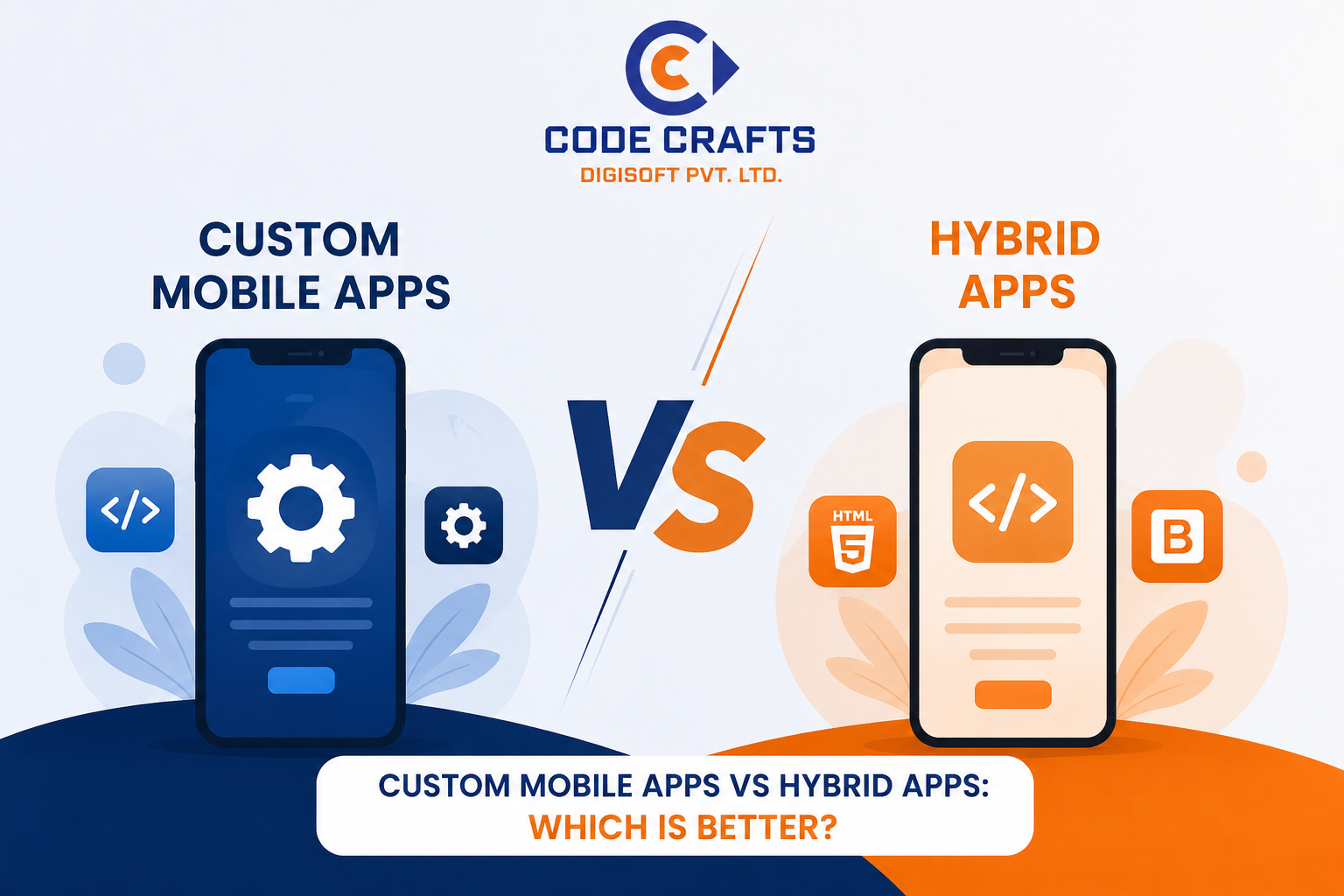
The two most common options are custom mobile apps and hybrid apps. Custom mobile apps are generally developed specifically for a particular operating system, such as Android or iOS. Hybrid apps, on the other hand, are created using a shared codebase that can run across multiple platforms.
But which approach is better for your business?
The answer depends on your target audience, budget, timeline, application features, and long-term business goals. In this blog, we compare custom and hybrid apps to help you make a practical decision.
What Are Custom Mobile Apps?
Custom mobile apps are applications built specifically for a business, platform, or operating system. In most cases, native Android apps are developed using technologies such as Kotlin or Java, while iOS apps may use Swift or Objective-C.
A custom app is designed around the unique needs of a business. It can include personalized features, platform-specific functionality, advanced security, and a user interface created specifically for the target audience.
For example, a financial institution may require biometric authentication, secure payment processing, real-time notifications, and fraud monitoring. A standard application may not provide the flexibility required for these features. A custom mobile app can be designed to support them from the beginning.
Businesses can use Android app development software and other application development software to create solutions that are highly optimized for individual platforms.
Benefits of Custom Mobile Apps
1. Better Performance
Custom apps are developed specifically for a particular platform. They can directly use the operating system’s resources and features, which often results in faster performance, smoother animations, and better responsiveness.
This is especially important for applications that process large amounts of data or require real-time functionality. Gaming apps, financial applications, video platforms, and enterprise software can benefit significantly from platform-specific development.
2. Superior User Experience
Android and iOS users interact with their devices differently. They are accustomed to specific navigation patterns, design elements, gestures, and interface behaviors.
A custom app can follow the design guidelines of each operating system. This makes the application feel natural and easier to use. A better user experience can improve engagement, retention, and customer satisfaction.
3. Greater Access to Device Features
Custom mobile applications can use a wide range of device capabilities, including:
- GPS and location services.
- Camera and microphone.
- Bluetooth and wearable devices.
- Biometric authentication.
- Push notifications.
- Accelerometer and gyroscope.
- Contact lists and calendars.
- Secure storage.
This makes custom apps suitable for businesses that need advanced functionality or deep integration with smartphones and connected devices.
4. Stronger Security
Security is a critical factor for fintech, healthcare, eCommerce, and enterprise applications. Custom development allows businesses to implement security measures according to their specific requirements.
These may include encrypted data transmission, multi-factor authentication, role-based access, secure APIs, biometric login, and customized fraud prevention features.
Although no application is completely risk-free, a custom development approach gives businesses greater control over security architecture and data protection.
5. Easier Long-Term Scalability
A custom app can be planned around future business requirements. New features, third-party integrations, user roles, and workflows can be added as the organization grows.
This is particularly useful for startups and growing businesses that want to launch a minimum viable product and gradually expand it. When the application is built on a flexible architecture, future changes are generally easier to manage.
What Are Hybrid Apps?
Hybrid apps are applications created using a common codebase that can work across multiple platforms. Instead of developing separate applications for Android and iOS from the ground up, developers can use a single development framework to create much of the application.
Popular hybrid and cross-platform technologies include Flutter, React Native, Ionic, and similar frameworks. These tools are often used with mobile app development software to reduce development time and simplify maintenance.
A hybrid app may combine web technologies with native device capabilities. Depending on the framework and project architecture, it can provide a user experience that is close to native applications.
Hybrid development is often chosen by businesses that want to launch an app on multiple platforms while working with a limited budget or a short deadline.
Benefits of Hybrid Apps
1. Faster Development
Because developers can reuse a significant portion of the codebase, hybrid apps can often be built faster than two separate native applications.
This can be valuable for businesses that want to test an idea, release a product quickly, or respond to a market opportunity. Faster development also allows companies to collect user feedback earlier.
2. Lower Initial Development Cost
Creating separate native applications for Android and iOS requires separate development efforts, testing processes, and sometimes separate teams. Hybrid development can reduce these initial costs by allowing developers to work with a shared codebase.
This makes hybrid apps a practical option for startups, small businesses, and companies validating a new product idea.
3. Easier Maintenance
When most of the application uses a shared codebase, developers can make updates more efficiently. A bug fix or design change may be applied across platforms without rewriting the same feature separately.
This can simplify maintenance and reduce the time needed for routine updates.
4. Wider Platform Reach
Hybrid apps make it easier to target Android and iOS users simultaneously. Businesses can reach a larger audience without waiting for two completely separate development cycles.
This is useful for customer-facing applications such as booking platforms, online marketplaces, educational products, and business service apps.
5. Suitable for Standard Applications
Many applications do not need highly complex device integrations or intensive processing. For these projects, hybrid development can provide an effective balance between functionality, speed, and cost.
Examples include:
- Business information apps.
- Content and news platforms.
- Appointment booking applications.
- Basic eCommerce apps.
- Event management apps.
- Customer portals.
- Internal employee applications.
Custom vs Hybrid Apps
The right approach depends on the needs of your project. The following comparison can help you understand the main differences.
| Factor | Custom mobile apps | Hybrid apps |
| Development approach | Built specifically for a platform or business | Built with a shared codebase for multiple platforms |
| Performance | Usually offers the highest performance | Good performance, depending on the framework and app complexity |
| Development time | Generally longer | Usually faster |
| Initial cost | Higher | Lower to moderate |
| User experience | Highly optimized for each platform | Consistent across platforms, but may require additional optimization |
| Device integration | Excellent access to native features | Good access, although certain advanced features may need native code |
| Maintenance | May require separate platform updates | Often simpler because of shared code |
| Scalability | Highly flexible for complex requirements | Scalable for many standard and moderately complex applications |
| Best suited for | High-performance, secure, and feature-rich apps | Cost-effective, multi-platform, and rapid-launch apps |
Which Option Is Better?
There is no universal answer. Custom and hybrid apps serve different business goals.
Choose Custom Mobile Apps When:
A custom mobile app may be the better option if:
- Your application requires advanced performance.
- You need extensive device integration.
- Your business handles sensitive financial or medical information.
- You need a highly personalized user experience.
- Your app includes complex animations or real-time processing.
- You plan to scale the product significantly.
- You require advanced offline capabilities.
- Your application depends on platform-specific functions.
For example, a fintech company developing a digital banking application may prefer custom development because security, reliability, transaction processing, and device authentication are essential.
Similarly, a logistics company that needs background location tracking, route optimization, and real-time driver updates may benefit from a custom approach.
Choose Hybrid Apps When:
A hybrid app may be more suitable if:
- You want to launch on Android and iOS at the same time.
- Your budget is limited.
- You need a minimum viable product.
- Your app has standard business functionality.
- You want to validate a business idea quickly.
- Your team prefers a shared development environment.
- You want to simplify regular maintenance.
- Your application does not require intensive graphics or advanced native integrations.
For example, a startup launching an appointment-booking platform may use hybrid development to release its first version quickly, test customer interest, and improve the product based on feedback.
How to Choose the Right App Development Software
The development tools selected for a project can influence its speed, flexibility, and future maintenance requirements. When evaluating app development software, businesses should consider more than its popularity.
Important factors include:
Platform Support
Check whether the software supports Android, iOS, or both. If you plan to target multiple platforms, a cross-platform tool may help reduce duplication.
Programming Language and Team Skills
The development tool should match the technical expertise of your development team. Choosing a technology that your team understands can improve productivity and reduce errors.
Performance Requirements
If your app needs high-speed processing, advanced graphics, or real-time operations, assess how well the software handles those requirements.
Integration Capabilities
Make sure the chosen application development software can integrate with APIs, payment gateways, analytics platforms, cloud services, databases, and third-party tools.
Security Features
For applications that handle user accounts, payments, or confidential information, review the framework’s security capabilities and the development team’s experience with secure implementation.
Community and Support
A well-supported framework can make it easier to find documentation, libraries, updates, and solutions to technical issues.
Future Scalability
The software should support your long-term plans. Consider whether it can handle more users, additional features, new integrations, and future platform changes.
Cost Considerations
Cost is often one of the biggest differences between custom and hybrid app development.
Custom applications generally require a larger initial investment because they may involve separate development efforts for Android and iOS. They may also require more testing and platform-specific optimization.
Hybrid applications can reduce initial costs by using one shared codebase. However, the total cost still depends on the complexity of the design, backend system, integrations, security requirements, testing, and ongoing maintenance.
Businesses should avoid choosing an approach only because it appears cheaper at the beginning. A low-cost solution may become expensive if it cannot support future features or creates performance issues.
Instead, evaluate the total cost of ownership, including:
- Planning and research.
- UI and UX design.
- Application development.
- Backend development.
- Testing and quality assurance.
- Deployment.
- Security updates.
- Maintenance.
- Feature enhancements.
- Technical support.
Why Choose Code Crafts Digisoft?
Code Crafts Digisoft Pvt. Ltd. is a Jaipur-based software development company providing web development, mobile app development, and customized digital solutions for startups, SMEs, and enterprises.
With experience across software development and digital transformation projects, Code Crafts Digisoft focuses on understanding each client’s business objectives before recommending a technology approach. The company follows a structured process that includes consultation, planning, development, launch, and ongoing support.
Businesses can work with Code Crafts Digisoft to evaluate whether custom or hybrid development is more appropriate for their application. The team can help assess project requirements, platform needs, security expectations, user experience goals, and future scalability.
Benefits of Working with Code Crafts Digisoft
Business-Focused Planning
The development process begins with understanding the company’s goals, users, challenges, and expected outcomes. This helps ensure that the application supports real business requirements instead of adding unnecessary features.
Customized Solutions
Code Crafts Digisoft develops software solutions based on the specific needs of each client. Whether the project requires a custom Android application, a hybrid mobile product, or a complete digital platform, the solution can be planned around the organization’s objectives.
Scalable Technology
The team focuses on creating solutions that can support future growth. This is important for businesses that expect to add new users, features, integrations, or services over time.
Professional Development Process
A clear development process helps businesses understand project stages, timelines, deliverables, and responsibilities. Code Crafts Digisoft follows a four-step approach: consultation, planning, development, and launch with support.
Ongoing Support
Application development does not end when the app is published. Updates, security improvements, bug fixes, performance monitoring, and feature enhancements are important for long-term success. Ongoing support helps keep the application reliable and competitive.
Final Thoughts
Custom and hybrid apps both offer valuable benefits. Custom mobile apps are ideal for businesses that need maximum performance, advanced security, deep device integration, and complete control over the user experience. Hybrid apps are often better for organizations that want faster development, lower initial costs, multi-platform reach, and simpler maintenance.
Before choosing between them, consider your application’s purpose, audience, features, budget, timeline, and long-term growth plans. The right development approach should support your business strategy rather than follow a one-size-fits-all trend.
With the right planning and technical guidance, Code Crafts Digisoft Pvt. Ltd. can help you select suitable mobile app development software and build a secure, scalable, and user-friendly application for your business.
Frequently Asked Questions
About Author

Codecrafts Digisoft
Expert content creator and technology enthusiast at Code crafts Digisoft Pvt. Ltd.